Scientific Sources (Semax / Selank)
Here are legit scientific links (PubMed/PMC) you can use on-page:

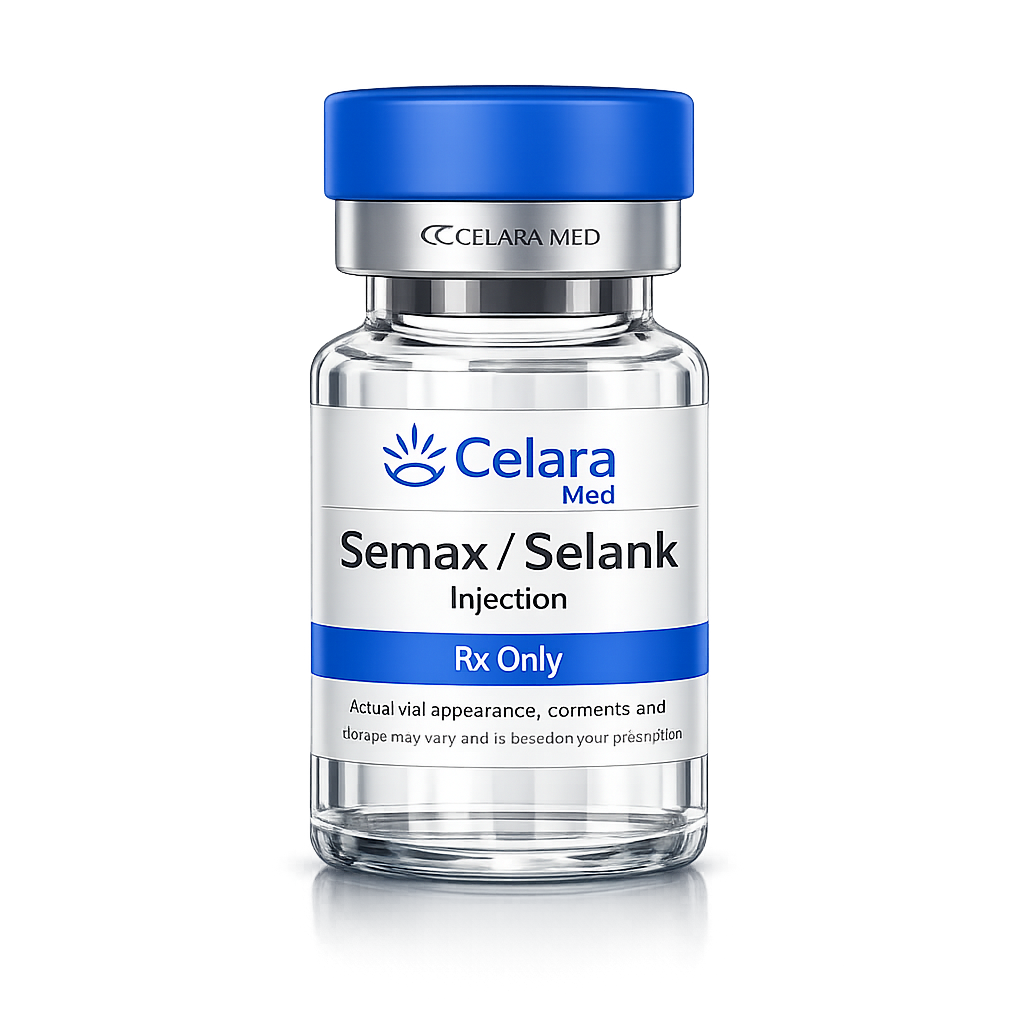
*Actual vial appearance, contents, and dosage may vary and is based on your prescription.
Selank has been studied in limited human research settings for anxiety-related symptom outcomes and in mechanistic studies for neurotransmission-related effects.
Semax has been investigated in published research for effects tied to neurotrophin signaling and cognitive-related pathways.
Both peptides have been studied for impacts on gene expression and brain-network/functional connectivity measures in research settings.
Semax appears in research literature evaluating peptide strategies in ischemia and neuroprotection models (primarily preclinical and limited clinical contexts).
Some research explores these peptides in the context of performance, stress resilience, and cognition-related outcomes (largely preclinical/early human).
Prescriptions are issued by licensed healthcare providers based on an individual clinical evaluation and medical eligibility. Compounded medications are not FDA-approved, and their safety and effectiveness have not been independently evaluated by the FDA.
This information is provided for educational purposes only and is not intended to diagnose, treat, cure, or prevent any disease.
Information provided is for educational purposes only and does not constitute medical advice. All care and prescriptions are provided solely at the discretion of a licensed healthcare provider following an individual evaluation.
Here are legit scientific links (PubMed/PMC) you can use on-page:
Hear from individuals who chose a more guided, informed approach to their wellness journey.


A Celara Med User

A Celara Med User
Quick answers to common questions, designed to help you feel clear and confident as you explore Celara Med.
Semax is more commonly studied in research for cognitive/neurotrophin-related pathways and neuroprotection models, while Selank is more commonly studied for anxiolytic-like effects and neurotransmission-related mechanisms.
Neither peptide is typically described as a stimulant in the scientific literature; effects studied relate more to signaling and regulation pathways than stimulant pharmacology.
Adults interested in cognitive performance support, stress-response support, or wellness-focused neuroregulation may be evaluated. Eligibility is determined by a licensed provider after reviewing history and goals.
A medical intake is reviewed by a licensed provider in your state, and a prescription is issued only if clinically appropriate.
Some individuals may experience mild and temporary effects such as headache, nausea, dizziness, or nasal irritation (if used intranasally), depending on formulation and individual sensitivity. Discuss risks with the provider during evaluation.
Responses vary. Any changes are typically gradual and influenced by individual physiology and consistency. Outcomes are not guaranteed.
In some cases, a provider may approve combination use depending on goals and clinical appropriateness.
Available in 48 states (excluding Alabama and Mississippi), subject to state regulations and provider licensure.
Yes—these are offered within a structured care plan designed for continuity and appropriate oversight.
Explore other provider-guided options that may better align with your goals.
Methylene blue is a synthetic compound with a long history of medical and scientific use. In contemporary research, low-dose methylene…